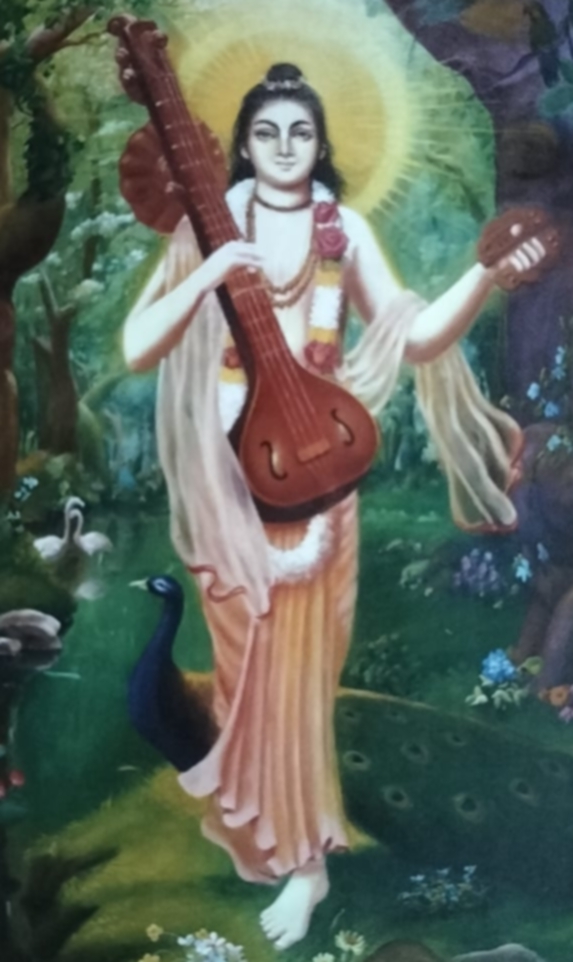
This is a Doxa (gr. praise, glory) for Narada Muni and Divine Company, and some context for the study of Narada Bhakti Sutra.

It’s autumn, around the new moon of October. October is a misnomer, it’s not the eighth month for us anymore. It maybe used to be, in Roman times. In a marvelous coincidence and leela of Devi, it is the eight month in the Hindu calendar, where the eight month is now and it is called Kartika. The Europen people have colonized themselves through their own greed and arrogance. Hubris, the old trap. Anyway, in România it used to be called Brumărel, literally ‘little frosty’ while November used to be Brumar, ‘frosty’. Well named, there’s no ice yet, but nature is progressively stiffening with cold. We have reached the Little Frosty new moon of the year, in Libra (tula rashi). New moon is Amavasya in Sanskrit, or ‘with live’. At every new moon, Sun and Moon are living together,, in the same sign, aligned as viewed from Earth – so the moon is invisible and it’s getting direct Sun darshan, to begin another leap around the Earth. Sun, Surya, Ra. Moon, Luna, Chandra, Soma. Earth, Gaia, Pachamama, Bhoomi, Sati, Sita. It is on this new moon of the year that Diwali is celebrated. It is also in this lunar cycle that all hallows’, all saints’ and all souls’ festivals happen. A liminal space in time, no doubt. The sunlight of the summer turns into the icy cloudiness of the winter. The warmth of the light turns into the cold stillness of darkness. Comparative darkness, we’re still not being frozen to death(lessness) like we probably would be on Jupiter. So, a period to be grateful, appreciate the blessings, Life in general, prana and the beauty of change. And give a nod to lord Yama, also, the greatest Siddha of astral infrastructure, and Hades and Pluto, the ones that are invisibly rich. Pluto has also just entered firmly into Aquarius (kumbha rashoi), in november last year. We celebrate the victory of Light & Truth over Darkness & Ignorance.
The sankalpa of this written contemplation is ‘guru bhakti’. What is Guru Bhakti?
Guru. Ah, MahaGuru, what to do? This happens everyday for everyone. The game of life is full of duality. Every moment we need to make decision with yes or no, 1 or 0, right or wrong. Deeper, the decisions are always about true or false, truth or ignorance. How to streamline myself with the law of the universe, Dharma and steer clear of the confusions of adharma? How to live with excellence, in a right good manner? How to be happy? Remember ‘Dharmo Rakshati Rakshitah’ and ‘As above, so below; as within, so without’. The Universe protects who protects the Universe. It’s win win. If I live in a right good manner, I’ll have a good experience of the whole thing. It’s an advisable thing to do, live in dharma. The four pillars of Dharma, says the Srimad Bhagavatam, are: Satya, Daya, Tapas, Shaucha. So far, so good, but what does this actually mean? How to practice it? How to live this knowledge?
In Romanian there is still the word ‘doct’, which used to exist in English also and it comes from the Greek ‘doxa’, which means glory. The connotation of ‘doct’ is some dusty academician who memorized many things but hasn’t experienced much. It is also where the word ‘doctrine’ comes from. A Siddha Yogi is something different, it’s another level of Thinker. Mind Mastery. Cittam Yogam. For this, mythically, one needs guidance. It is recommended to stand on the shoulders of giants, use intelligence and find a guru path. Guru, as famously and beautifully described by Jaggi Vasudev Sadhguru, is the one who dispels darkness, with ‘gu’ being darkness and ‘ru’, dispel. Life is definitely a Guru, everyone’s life is their main and undebatable Guru. But it’s an unclear Guru, that speaks to us through many layers, from all the way deep into turyatita dark void of collective subconscious. Also, it speaks in silence and jibberish. Not understandable. The Guru is the mirror that helps us decipher Truth. Everybody has gurus in life, whether we call them that or not. All the mentors, geniuses, muses and other existential influencers are our gurus. Inner guides and also guidance from the environment. The human being is not the only place where consciousness resides. It is everywhere, it communicates and it responds to communication. Still, these on-off life gurus are too loose. One could benefit from consistent, productive feedback from a clear mutually appointed Guru. A Guru’s energy would be the golden pranic egg for the growing yogi, the Kamadhenu of Dharma. Basically, a Guru would be moksha, liberation from the conflict of right and wrong, liberation from death and rebirth, liberation from duality.
I’ve been using Mahavatar Babaji Nagaraj as a Guru and I think something in the universe is aware of this decision of mine because I have been bombarded with coincidences all my life. Finding out about Guru Pashupati was one of those coincidental affirmations. Practicing the kriyas he teaches was a life saving operation at a crucial point in my lifedeath. We should call it lifedeath, like we use the term bodymind. I’ve been astrally projecting with all my focus recently and I’ve been reminded a lot about Narada Muni. Narayana, Narayana. Om Namo Narayan! He was a Gandharva once and he is the original siddha journalist of all the three worlds (at least).
And Bhakti? A Sanskrit word often translated as ‘devotion’, a Latin derivate that has to do with ‘deus’ (God) and ‘votare’. With which God do I vote? And then, what actions should I do to bask in his guidance? Speaking of basking in the Sun, Surya is Hanuman’s Guru. Hanuman is the original Bhakt, there’s no doubt about that. Again, the first personal encounter I had with Hanuman was in Varanasi, where he holds Sanchat Mochan Sangeet Samaroh every year, showing Sita and Rama sitting in his heart while he plays bhajans for them. Nothing but outpouring bhakti prem for Rama and Sita and their Silver Age dimension of existence. He sits by the Ganga on the ghats, holding up a bridge and a tower (of course) as he sips from Ganga Ji when she rises during floods. His Guru is Surya and his Guru is also Narada Muni. In was in the Sankat Mochan Hanuman Mandir in Varanasi where I first heard the story about Narada Muni and ‘mara-rama’. Someone is cursed and can’t repeat ‘Rama’ (name of God and life) and purify themselves, so Narada tells them to repeat ‘mara’ (death) – whichever one you say continuously, they merge into the same. It didn’t register with me then that the someone was a robber who after this trick became Valmiki Rishi, the one who wrote (Valmiki) Ramayana.
All roads have led us to Narada, probably because he sits around every crossroad. Narayana, Narayana! Jai, Jai! As such, let’s have an immersive dive into the Narada Bhakti Sutra.

I use a copy of Narada Bhakti Sutra published by the International Society for Krishna Consciousness, facilitated by the grace of A.C.Bhaktivedanta Swami Prabhupada and his disciplines. Jai Prabhuji! Radhe Radhe. Haribol.
NARADA – BHAKTI – SUTRA
– THE SECRETS OF TRANSCENDENTAL LOVE –
– the value of devotion –
sutra 1
athato bhaktim vyakhyasmyamah
now, therefore, we will try to explain the process of devotional service (bhaktim).
sutra 2
sa tv asmin parama-prema-rupa
it manifests as the most elevated, pure love for the Absolute.
sutra 3
amrta-svarupa ca
it is the essence of eternity.
sutra 4
yal labdva puman siddho bhavaty amrto bhavati trpto bhavati
having gained it, a person becomes perfect, immortal, and peaceful.
sutra 5
yat prapya na kincid vanchati na socati na dvesti na ramate notsahi bhavati
having attained it, a person doesn’t desire sense gratification, doesn’t lament any loss,
doesn’t hate anything, doesn’t enjoy anything
on his personal account, doesn’t become materialistically enthusiastic.
sutra 6
yaj jnatva matto bhavati stabdho bhavaty
atmaramo bhavati
having known transcendental service, a person becomes intoxicated, stunned in ecstasy and enjoys his whole Self, being engaged in transcendental service of the Supreme Self.
sutra 7
sa na kamayamana nirodha-rupatvat
it is not like ordinary lust because material activities are renounced.
sutra 8
nirodhas tu loka-veda-vyyapara-nyasah
such renunciation in transcendental service means giving up worldly customs and Vedic rituals.
sutra 9
tasminn ananyata tad-virodhisudasinata ca
renunciation means being exclusively dedicated to it and totally indifferent to what stands in the way.
sutra 10
anyasrayanam tyago nanyata
exclusive dedication means giving up all other shelter.
sutra 11
loka-vedesu tad-anukulacaranam tad-virodhisudasinata
indifference towards what stands in the way means only accepting the worldly customs and Vedic rituals that are favourable.
sutra 12
bhavatu niscaya-dardhyad urdhvam
sastra-rakshanam
let there be, from firm resolve onward, the protection of the scriptures.
sutra 13
anyatha patitya-sankaya
otherwise there is every possibility of falling down.
sutra 14
loke pi tavad eva bhojanadi-vyaparas tv a-sarira-dharanavadhi
as long as the body lasts, one should engage minimally in social and political activities and activities like eating.
– defining bhakti –
sutra 15
tal-lakshanani vacyante nana-mata-bhedat
the characteristics of transcendental devotional service according to various authoritative opinions.
sutra 16
pujadisv anuraga iti parasaryah
Srila Vyasadeva, son of Parasara Muni,
says that bhakti is fond attachment for worshiping the Lord.
sutra 17
kathadisv iti gargah
Garga Muni says that bhakti is fondness for narrations about the Lord.
sutra 18
atma-raty-avirodheneti sandilyah
Sandilya says that bhakti results from removing all obstructions to taking pleasure in the Supreme Self.
sutra 19
naradas tu tad-arpitakhilacarata tad-vismarane parama-vyakulateti
Narada says that bhakti is offering every act to the Supreme Lord and feeling extreme distress in forgetting Him.
sutra 20
asty evam evam
Bhakti is like each of these.
sutra 21
yatha vraja-gopikanam
the Gopis of Vraja are an example of pure bhakti.
sutra 22
tatrapi na mahatmya-jnana-vismrty-apavadah
Gopis cannot pe criticized for forgetting the Lord’s greatness.
sutra 23
tad-vihinam jaranam-iva
displays of devotion without knowledge of God’s greatness are no better than the affairs of illicit lovers.
sutra 24
nasty eva tasmims tat-sukha-sukhitvam
in such false devotion one doesn’t find pleasure exclusively in the Lord’s pleasure.
sutra 25
sa tu karma-jnana-yogebhyo py adhikatara
pure devotional service is far superior to work, knowledge or meditation.
sutra 26
phala-rupatvat
Bhakti is the fruit of all endeavor.
sutra 27
isvarasyapy abhimani-dvesitvad dainya-priyatvac ca
the Lord dislikes the proud and is pleased with the humble
sutra 28
tasya jnanam eva sadhanam ity eke
some say jnana leads to bhakti.
sutra 29
anyonyasrayatvam ity eke
others consider bhakti and jnana interdependent.
sutra 30
svayam phala-rupeti brahma-kumarah
the son of Brahma says bhakti is its own fruit.
sutra 31-32
raja-grha-bhojanadisu tathaiva drstatvat na tena raja-paritosah ksuc-chantir va
a king is not satisfied just by seeing the palace, nor can someone placate hunger just by looking at a meal.
sutra 33
asmatsaiva grahya mumuksubhih
therefore seekers of liberation should take to transcendental service.
– the means of achievement –
sutra 34
tasyah sadhanani gayanty acaryah
great teachers have described the methods for achieving devotional service.
sutra 35
tat tu visaya-tyagat sanga-tyagac ca
one achieves bhakti by giving up sense gratification and mundane association.
sutra 36
avyavrtta-bhajanat
uninterrupted worship (bhajan).
sutra 37
loke pi bhagavad-guna-sravana-kirtanat
hear and chant the Lord’s special qualities (kirtan) even during worldly activities.
sutra 38
mukhyatas tu mahat-krpayaiva
bhagavat-krpa-lesad va
primarily, one develops bhakti by the mercy of Great Souls, or by a small drop of the Lord’s mercy.
sutra 39
mahat-sangas tu durlabho gamyo moghas ca
the association of Great Souls is rarely obtained, difficult to understand, and infallible.
sutra 40
labhyate pi tat-krpayaiva
it is gained by His mercy.
sutra 41
tasmims taj-jane bhedabhavat
the Lord and His pure devotees are nondifferent.
sutra 42
tad eva sadhyatam tad eva sadhyatam
strive only for the association of pure devotees.
sutra 43
duhsangam sarvathaiva tyajyah
give up all degrading association.
sutra 44
kama-krodha-moha-smrti-bhramsa-buddhi-nasa-sarva-nasa-karanatvat
it leads tp lust, anger, confusion, forgetfulness, loss of intelligence, total calamity.
sutra 45
tarangita apime sangat samudrayanti
forming waves, these material associations create an ocean of misery.
sutra 46
kas taratikas tarati mayam yah sangam tyajati yo mahanubhavam sevate nirmano bhavati
who can cross beyond illusion? one who abandons material association, serves the sages and becomes selfless.
sutra 47
yo vivikta-sthanam sevate yo loka-bandham unmulayati nistraigunyo bhavati yo yoga-ksemam tyajati
who stays in a secluded place, cuts off at the root of his attachment to mundane society, becomes free from the influence of the three modes of nature and gives up om material gain and security.
sutra 48
yah karma-phalam karmani sanyasyati tato nirdvandvo bhavati
who renounces mterial duties and their profits, transcending duality.
sutra 49
yo vedan api sanyasyati kevalam avicchinnanuragam labhate
who renounces even Vedas obtains exclusive and uninterrupted attraction for God.
sutra 50
sa tarati sa tarati lokams tarayati
such a person is delivered and delivers the rest of the world.
– pure and mixed devotion –
sutra 51
anirvacaniyam prema-svarupam
the true nature of pure love of God is beyond description.
sutra 52
mukasvadana-vat
like a mute’s effort to describe what he tastes.
sutra 53
prakasyate kvapi patre
sometimes it is revealed to those who are qualified.
sutra 54
guna-rahitam kamana-rahitam pratiksana-vardhamanam avicchinnam sukshma-taram anubhava-rupam
pure love of God manifests as the most subtle consciousness, devoid of material qualities and material desires, increasing at every moment, and never interrupted.
sutra 55
tat prapya tad evavalokayati tad eva srnotitad eva bhasayati tad eva cintayati
having obtained it, one looks only at the Lord, hears, speaks and thinks only about Him.
sutra 56
gauni tridha guna-bhedad artadi-bhedad va
secondary devotional service is of three kinds, according to which of the three material modes predominates, or according to which material motivation brings one to bhakti.
sutra 57
uttarasmad uttaraasmat purva-purvosreyaya bhavati
each earlier stage should be considered better than the one following it.
sutra 58
anyasmat saulabhyam bhaktau
success is easier to obtain by devotional service than by any other process.
sutra 59
pramanantarasyanapeksatvat svayam pramanatvat
because it doesn’t depend on any other authority for its validity, being itself the standard of authority.
sutra 60
santi-rupatparamananda-rupac ca
bhakti is the embodiment of peace and supreme ecstasy.
sutra 61
loka-hanau cinta na karya niveditatma-loka-vedatvat
after consigning to the Lord all one’s mundane and Vedic duties, one no longer need worry about worldly loss.
sutra 62
na tatsiddhau loka-vyavaharo heyah kintu phala-tyagas tat-sadhanam ca karyam eva
even after one has achieved devotional service, one should not abandon one’s responsibilities in this world but should rather continue surrendering the results of one’s work to the Lord.
sutra 63
stri-dhana-nastika-caritram na sravaniyam
do not find entertainment in news of women, money and atheists.
sutra 64
abhimana-dambhadikam tyajyam
put aside false pride, hypocrisy and other vices.
sutra 65
tad arpitakhilacarah san kama-krodhabhimanadikam tasminn eva karaniyam
offer all activities to the Lord and feel desire, anger and pride only in regards to Him.
sutra 66
tri-rupa-bhanga-purvakam nitya-dasya-nitya-kanta-bhajanatmakam prema karyam premaiva karyam
after breaking through the coverings of the three modes of nature, act only in pure love of God, remain always in the mood of a servant serving his master, or a lover serving his beloved.
sutra 67
bhakta ekantino mukhyah
the greates devotees are those dedicated to Him as His intimate servants.
sutra 68
kanthavarodha-romasrubhih parasparam lapamanah pavayanti kulani prthivim ca
with throats choked, hair standing on end and tears flowing, the Lord’s intimate servants purify their own followers and the whole world.
sutra 69
tirthi-kurvanti tirthani su-karmi-kurvanti karmani sac-chastri-kurvanti sastrani
their association makes holy places holy, works auspicious and the scriptures authoritative.
sutra 70
tan-mayah
they are filled with and fully absorbed in Him.
sutra 71
modante pitaro nrtyanti devatah sa-natha ceyam bhur bhavati
the pure devotees’ forefathers become joyful, the demigods dance, the world feels protected by good masters.
sutra 72
nasti tesujati-vidy-rupa-kula-dhana-kriyadi-bhedah
there are no distinctions among pure devotees in terms of social class, education, bodily beauty, family status, wealth, occupation.
sutra 73
yatas tadiyah
they are His.
– attaining perfection –
sutra 74
vado navalambyah
Argumentative debate should not be indulged in.
sutra 75
bahulyavakasatvad aniyatatvac ca
such argumentation leads to excessive entanglements and is never decisive.
sutra 76
bhakti-sastrani mananiyani tad-bhodaka-karmani karaniyani
respect the revered scriptures of devotional service and discharge the duties they prescribe.
sutra 77
sukha-duhkheccha-labhadi-tyakte kale pratiksamane ksanardham api vyartham na neyam
patiently waiting until one can put aside material happiness, distress, desire, and false gain, one should not waste a fraction of a second.
sutra 78
ahimsa-satya-sauca-dayastikyadi-caritryani paripalaniyani
one should cultivate qualities such as nonviolence, truthfulness, cleanliness, compassion, and faith.
sutra 79
sarvada sarva-bhavena niscintair bhagavan eva bhajaniyah
those who are free of doubts should constantly worship the Supreme Lord with all their hearts.
sutra 80
sa kirtyamanah sighram evavirbhavaty anubhavayati bhaktan
when He is glorified, the Lord swiftly reveals Himself to His devotees and allows them to know Him as He is.
sutra 81
tri-satyasya bhaktir eva gariyasi bhaktir eva gariyasi
devotional service is the most precious possession of a person who honestly uses his mind, body, and words.
sutra 82
guna-mahatmyasakti-rupasakti- pujasakti-smaranasakti-dasyasakti- sakhyasakti-vatsatyasakti-kantasakti-atma-nivedanasakti-tan-mayasakti-parama-virahasakti-rupai kadhapi ekadasadha bhavati
devotional service is one and it becomes manifested in 11 forms of attachment: attachment to the Lord’s glorious qualities, to His beauty, to worshipping Him, to remembering Him, to serving Him, to reciprocating with Him as a friend, to caring for Him as a parent, to dealing with Him as a lover, to surrendering one’s whole self to Him, to being absorbed in thought of Him, and to experiencing separation from Him. This last is the supreme attachment.
sutra 83
ity evam vadanti jana-jalpa-nirbhaya eka-matah kumara-vyasa-suka-sandilya-garga-visnu-kaundilya-sesoddhavaruni-bali-hanumad-vibhisanadayo bhakty-acaryah
thus say the founding authorities of devotional service: the Kumaras, Vyasa, Suka, Sandilya, Garga, Visnu, Kaundilya, Sesa, Uddhava, Aruni, Bali, Hanuman, Vibhisana, and others – speaking without fear of wordly gossip and sharing among themselves one and the same opinion.
sutra 84
ya idam narada-proktam sivanusasanam visvasiti sraddhate sa bhaktiman bhavatisa prestham labhate sa prestham labhata iti
anyone who trusts these instructions spoken by Narada and is convinced by them will be blessed with devotion and attain the most dear Lord. Yes, he will attain the most dear Lord.
NARADA – BHAKTI – SUTRA
– THE SECRETS OF TRANSCENDENTAL LOVE –
sutra 1
athato bhaktim vyakhyasmyamah
atha – now
atah – therefore
bhaktim – devotional service
vyakhyasyamah – shall try to explain
sutra 2
sa tv asmin parama-prema-rupa
sa – it
tu – and
asmin – for Him
parama – highest
prema – pure love
rupa – having as its form
sutra 3
amrta-svarupa ca
amrta – immortality
svarupa – having as its essence
ca – and
sutra 4
yal labdva puman siddho bhavaty
amrto bhavati trpto bhavati
yat – which
labdha – having gained
puman – a person
siddhah – perfect
bhavati – becomes
amrtah – immortal
trptah – peaceful
sutra 5
yat prapya na kincid vanchati na socati na dvesti na ramate notsahi bhavati
yat – which
prapya – having attained
na kinchit – nothing
vanchati – hankers for
na socati – does not lament
na dvesi – does not hate
na ramate – does not rejoice
na – not
utsahi – materially enthusiastic
bhavati – becomes
sutra 6
yaj jnatva matto bhavati stabdho bhavaty atmaramo bhavati
yat – which
jnatva – having known
mattah – intoxicated
bhavagti – becomes
stabdhah – stunned in ecstasy
atma-aramah – self-content (because of
being engaged in the service of the Lord)
sutra 7
sa na kamayamana nirodha-rupatvat
sa – that
na – not
kamayamana – like ordinary lust
nirodha – renunciation
rupatvat – because of having as its form
sutra 8
nirodhas tu loka-veda-vyyapara-nyasah
nirodhah – renunciation
tu – moreover
loka – worldly
veda – scripture and rituals
vyapara – engagements
nyasa – renunciation
sutra 9
tasminn ananyata tad-virodhisudasinata ca
tasmin – for Him
ananyata – exclusive dedication
tat – to Him
virodhisu – for those things which are opposed
udasinata – indiference
ca – and
sutra 10
anyasrayanam tyago nanyata
anya – other
asrayanam – of shelters
tyagah – the giving up
an-anyata – exclusiveness
sutra 11
loka-vedesu tad-anukulacaranam tad-virodhisudasinata
loka – worldly
veda – scripture and rituals
tat – for that
anukula – of what is favourable
acaranam – performance
tat – for that
virodhisu – for what is opposed
udasinata – indifference
sutra 12
bhavatu niscaya-dardhyad urdhvam
sastra-rakshanam
bhavatu – let there be
niscaya – of certainty
dardhyat – the firm fixing
urdhvam – after
sastra – of scripture
raksanam – the observance
sutra 13
anyatha patitya-sankaya
anyatha – otherwise
patitya – of falling down
sankaya – because of anticipating the possibility
sutra 14
loke pi tavad eva bhojanadi-vyaparas
tv a-sarira-dharanavadhi
loke – in worldly behaviour
api – also
tavat – for that long
eva – indeed
bhojana – eating
adi – and so on
vyaparah – the activity
tu – and
a-sarira—dharana-avadhi
sutra 15
tal-lakshanani vacyante nana-mata-bhedat
tat – of it (devotional service)
lakshanani – the characteristics
vacyante – are enunciated
nana – various
mata – of theories
bhedat – according to the differences
sutra 16
pujadisv anuraga iti parasaryah
puja-adisu – for worship and so on
anuragah – fondness
iti – so thinks
parasaryah – Vyasadeva, the son of Parasara
sutra 17
kathadisv iti gargah
katha-adtisu – for narrations and so on
iti – so
garga – Garga Muni
sutra 18
atma-raty-avirodheneti sandilyah
atma – in relation with the Supreme Soul
rati – of pleasure
avirodhena – by freedom from obstruction
iti – so
sandilyah – Sandilya
sutra 19
naradas tu tad-arpitakhilacarata tad-vismarane parama-vyakulateti
naradah – Narada
tu – but
tat – to Him
arpita – offered
akhila – all
acarata – having one’s activities
tat – Him
vismarane – in forgetting
parama – supreme
vyakulata – distress
iti – so
sutra 20
asty evam evam
asti – it is
evam evam – like each of these
sutra 21
yatha vraja-gopikanam
yatha – as
vraja – of Vraja
gopikanam – of the gopis (cowherd women of Vraja)
sutra 22
tatrapi na mahatmya-jnana-vismrty-apavadah
tatra – in that case
api – even
na – there is not
mahatmya – of greatness
jnana – of awareness
vismrti – of forgetting
apavadah – criticism
sutra 23
tad-vihinam jaranam-iva
tat – of it (awareness of the Lord’s greatness)
vihinam – devoid
jaranam – of ilicit lovers
iva – like
sutra 24
nasty eva tasmims tat-sukha-sukhitvam
na – there is not
eva – indeed
tasmin – in it
tat – His
sukha – in the happiness
sukhitvam – finding happiness
sutra 25
sa tu karma-jnana-yogebhyo py adhikatara
sa – it
tu – but
karma – to fruitive work
jnana – speculative knowledge
yogebhyah – and mystic meditation
api – indeed
adhikatara – superior
sutra 26
phala-rupatvat
phala – of the fruit
rupatvat – because of being the form
sutra 27
isvarasyapy abhimani-dvesitvad
dainya-priyatvac ca
isvarasya – of the Supreme Lord
api – also
abhimani – of those who are proud
dvesitvat – because of being one who dislikes
dainya – of humility
priyatvat – because of being fond
ca – and
sutra 28
tasya jnanam eva sadhanam ity eke
tasyah – of it (bhakti)
jnanam – knowledge
eva – alone
sadhanam – the means
iti – thus
eke – some
sutra 29
anyonyasrayatvam ity eke
anyonya – mutual
asrayatvam – dependency
iti – thus
eke – some
sutra 30
svayam phala-rupeti brahma-kumarah
svayam – itself
phala-rupa – manifesting as its fruit
iti – thus
brahma-kumarah – the son of Brahma (Narada)
sutra 31-32
raja-grha-bhojanadisu tathaiva drstatvat na tena raja-paritosah ksuc-chantir va
raja – royal
grha – in a residence
bhojana – in a meal
adisu – and so on
tatha eva – just like this
drstatvat – because of its been seen
na – not
tena – by that
raja – of the king
paritosah – satisfaction
ksut – of hunger
santih – pacification
va – or
sutra 33
asmatsaiva grahya mumuksubhih
asmat – therefore
sa – it
eva – only
grahya – should be accepted
mumuksubhih – by persons desiring liberation
sutra 34
tasyah sadhanani gayanty acaryah
tasyah – of it
sadhanani – the means of development
gayanti – sing
acaryah – the great teachers
sutra 35
tat tu visaya-tyagat sanga-tyagac ca
tat – that
tu – and
visaya – of sense gratification
tyagat – by rejection
sanga – of (material) association
tyagat – by rejection
ca – and
sutra 36
avyavrtta-bhajanat
avyavrtta – uninterrupted
bhajanat – by worship
sutra 37
loke pi bhagavad-guna-sravana-kirtanat
loke – in the world
api – even
bhagavat – of the Supreme Lord
guna – about the qualities
sravana – by hearing
kirtanat – and chanting
sutra 38
mukhyatas tu mahat-krpayaiva
bhagavat-krpa-lesad va
mukhyatah – primarily
tu – but
mahat – of great souls
krpaya – by the mercy
eva – indeed
bhagavat – of the Supreme Lord
krpa – of the mercy
lesat – by a trace
va – or
sutra 39
mahat-sangas tu durlabho gamyo moghas ca
mahat – of great souls
sangah – the association
tu – but
durlabhah – difficult to achieve
agamyah – difficult to understand
amoghah – infallible
ca – also
sutra 40
labhyate pi tat-krpayaiva
labhyate – it is gained
api – yet
tat – of Him (the Supreme Lord)
krpaya – by the mercy
eva – only
sutra 41
tasmims taj-jane bhedabhavat
tasmin – in Him
tat – His
jane – in the people
bheda – of difference
abhavat – because of the absence
sutra 42
tad eva sadhyatam tad eva sadhyatam
tat – that
eva – only
adhyatam- should be strived for
tat – that
eva – only
sadhyatam – should be strived for
sutra 43
duhsangam sarvathaiva tyajyah
duhsangam – bad associations
sarvatha – in all its aspects
eva – indeed
tyajyah – to be given up
sutra 44
kama-krodha-moha-smrti-bhramsa-buddhi-nasa-sarva-nasa-karanatvat
kama – of lust
krodha – anger
moha – bewilderment
smrti-bhramsa – failure of memory
buddhi-nasa – loss of intelligence
sarva-nasa – and total loss
karanatvat – because of being the cause
sutra 45
tarangita apime sangat samudrayanti
tarangitah – forming waves
api – indeed
ime – these
sangat – from material association
samudrayanti – create an ocean
sutra 46
kas tarati kas tarati mayam yah sangam tyajati yo mahanubhavam sevate nirmano bhavati
kah – who
tarati – crosses beyond
mayam – illusion
yah – he who
sangam – material association
tyajati – abandons
maha-anubhavam – wise person
sevate – serves
nirmamah – free from false proprietorship
bhavati – becomes
sutra 47
yo vivikta-sthanam sevate yo loka-bandham unmulayati nistraigunyo bhavati yo yoga-ksemam tyajati
yah – who
vivikta – secluded
sthanam – a place
sevate – serves
loka – wordly
bandham – the bondage
unmulayati – uproots
nistrai-gunyah – free from the influence of the three modesof material nature
bhavati – becomes
yoga – (desire for) gain
ksemam – and security
tyajati – gives up
sutra 48
yah karma-phalam karmani sanyasyati tato nirdvandvo bhavati
yah – who
karma-phalam – fruit of material world
karmani – his material activities
sanyasati – resigns
tatah – thus
nirdvandvah – unaffected by dualities
bhavati – becomes
sutra 49
yo vedan api sanyasyati kevalam avicchinnanuragam labhate
yah – who
vedan – the Vedas
api – even
sanyasyati – renounces
kevalam – exclusive
avicchinna – uninterrupted
anuragam – loving attraction
labhate – obtains
sutra 50
sa tarati sa tarati lokams tarayati
sah – he
tarati – crosses beyond
lokan – the people of this world
tarayati – he makes cross beyond
sutra 51
anirvacaniyam prema-svarupam
anirvacaniyam – beyond description
prema – mature love of God
svarupam – essential identity
sutra 52
mukasvadana-vat
muka – of a mute
asvadana – the tasting
vat – like
sutra 53
prakasyate kvapi patre
prakasyate – it is revealed
kva api – sometimes
patre – to a fit recipient
sutra 54
guna-rahitam kamana-rahitam pratiksana-vardhamanam avicchinnam sukshma-taram anubhava-rupam
guna – material qualities
rahitam – devoid of
kamana – material desire
pratiksana – at every moment
var-dhamanam – increasing
avicchinnam – uninterrupted
suksma-taram- most subtle
anubhava – consciousness
rupam – as its form
sutra 55
tat prapya tad evavalokayati tad eva srnotitad eva bhasayati tad eva cintayati
tat – it
prapya – having obtained
tat – Him
eva – alone
ava okayati – one looks at
srnoti – one hears about
bhasayati – one speaks about
cintayati – one thinks about
sutra 56
gauni tridha guna-bhedad artadi-bhedad va
gauni – secondary, mixed with the material modes
tridha – threefold
guna – of the material modes
bhedat – by the differentiation
arta – of the one who is distressed
adi – and so on
va – or
sutra 57
uttarasmad uttaraasmat purva-purvosreyaya bhavati
uttarasmat uttarasmat – than each later one
purva-purvah – each earlier one
sreyaya bhavati – is to be considered better
sutra 58
anyasmat saulabhyam bhaktau
anyasmat – than anything else
saulabhyam – ease of attachment
bhaktau – in devotional service
sutra 59
pramanantarasyanapeksatvat svayam pramanatvat
pramana – means of valid knowing
antarasya – another
apeksatvat – because of not being dependant on
svayam – in its own right
pramanatvat – because of being a valid authority
sutra 60
santi-rupatparamananda-rupac ca
santi – peace
rupat – because of (being) the form
parama – topmost
ananda – of pleasure
rupat – because of (being) the form
ca – and
sutra 61
loka-hanau cinta na karya niveditatma-loka-vedatvat
loka – of the world
hanau – about loss
cinta – worry
na karya – should not be done
nivedita – because of having surrendered
atma – one’s own
loka – mundane affairs
vedatvat – and Vedic studies
sutra 62
na tatsiddhau loka-vyavaharo heyah kintu phala-tyagas tat-sadhanam ca karyam eva
na – not
tat – of it (devotional service)
siddhau – in the achievement
loka – mundane
vyavaharat – business
heyah – to be abandoned
kintu – rather
phala – of the results
tyagah – abandonment
ca – and
karyam – must be done
eva – indeed
sutra 63
stri-dhana-nastika-caritram na sravaniyam
stri – of women
dhana – wealth
nastika – and atheists
caritram – stories
nasravaniyam – should not be listened to
sutra 64
abhimana-dambhadikam tyajyam
abhimana – pride
dambha – deceit
adikam – and so on
tyajyam – should be given up
sutra 65
tad arpitakhilacarah san kama-krodhabhimanadikam tasminn eva karaniyam
tat – to Him
arpita – having offered
akhila – all
acarah – actions
abhimana – pride
adikam – and so on
tasmin – toward Him
eva – only
karaniyam – should be done
sutra 66
tri-rupa-bhanga-purvakam nitya-dasya-nitya-kanta-bhajanatmakam prema karyam premaiva karyam
tri-rupa – of the three material forms (qualities of goodness, passions and ignorance)
bhanga – the breaking
purvakam – preceded by
nitya – perpetual
dasya – servitude
kanta – as a lover
bhajana – service
atmakam – consisting of
prema – pure love
karyam – one should manifest
eva – alone
sutra 67
bhakta ekantino mukhyah
bhaktah – devotess
ekantinah – exclusive
mukhyah – principal
sutra 68
kanthavarodha-romasrubhih parasparam
lapamanah pavayanti kulani prthivim ca
kantha – of the throat
avarodha – with blockage
roma – with bodily hair (standing erect)
asrubhih – and with tears
parasparam – among one another
lapamanah – conversing
pavayanti – they purify
kurani – their communities
prthivim – the earth
ca – and
sutra 69
tirthi-kurvanti tirthani su-karmi-kurvanti karmani sac-chastri-kurvanti sastrani
tirthi – into holy places
kurvanti – they make
tirthani – the holy places
su-karmi – into auspicious works
karmani – works
sat – pure
sastri – into scriptures
sastrani – the scriptures
sutra 70
tan-mayah
tat – with Him
mayah – filled
sutra 71
modante pitaro nrtyanti devatah sa-natha ceyam bhur bhavati
modante – become joyful
pitarah – forefathers
nrtyanti – dance
devatah – demigods
sa-natha – having good masters
ca – and
iyam – this
bhuh – earth
bhavati – becomes
sutra 72
nasti tesujati-vidy-rupa-kula-dhana-kriyadi-bhedah
na asti – there is not
tesu – in them
jati – of class
vidya – education
rupa – beauty
kula – family
dhana – wealth
kriya – occupation
adi – and so on
bhedah – difference
sutra 73
yatas tadiyah
yatah – because
tadiyah – His
sutra 74
vado navalambyah
vadah – debate
na – not
avalambyahh – to be resorted to
sutra 75
bahulyavakasatvad aniyatatvac ca
bahulya – for excessiveness
avakasatvat – because of involving opportunities
aniyatatvat – because of not being decisive
ca – and
sutra 76
bhakti-sastrani mananiyani tad-bhodaka-karmani karaniyani
bhakti – of devotional service
sastrani – scriptures
mananiyani – should be respected
tat – by them
bodhaka – make known
karmani – prescribed activities
karaniyani – should be executed
sutra 77
sukha-duhkheccha-labhadi-tyakte kale pratiksamane ksanardham api vyartham na neyam
sukha – happiness
dukha – unhappiness
iccha – will
labha – profiteering
adi – and so on
tyakte – having given up
kale – the time
pratiksamane – being waited for
ksana – of a moment
ardham – one half
api – even
vyartham – vainly
na neyam – should not be wasted
sutra 78
ahimsa-satya-sauca-dayastikyadi-caritryani paripalaniyani
ahimsa – of non-violence
satya – truthfulness
sauca – cleanliness
daya – compassion
astikya – faith
adi – and so on
caritryani – the characteristics
paripalaniyani – should be cultivated
sutra 79
sarvada sarva-bhavena niscintair bhagavan eva bhajaniyah
sarvada – always
sarva-bhavena – with all one’s feeling
niscintaih – by those who are free from doubt
bhagavan – the Supreme Lord
eva – indeed
bhajaniyah – should be worshipped
sutra 80
sa kirtyamanah sighram evavirbhavaty anubhavayati bhaktan
sah – He
kirtyamanah – being glorified
sighram – quickly
eva – indeed
avirbhavati – appears
anubhavayati – given realization
bhaktan – to the devotees
sutra 81
tri-satyasya bhaktir eva gariyasi bhaktir eva gariyasi
tri – in three ways (by his mind, body, and words)
satyasya – for one who is truthful
bhaktih – devotional service
eva – alone
gariyasi – most dear
sutra 82
guna-mahatmyasakti-rupasakti-pujasakti-smaranasakti-dasyasakti-sakhyasakti- vatsatyasakti-kantasakti-atma-nivedanasakti-tan-mayasakti-parama-virahasakti-rupai kadhapi ekadasadha bhavati
guna – of the Lord’s qualities
mahatmaya – to the greatness
asakti – attachment
rupa – to His beauty
puja – to worship
smarana – to remembrance
dasya – to service
sakhya – to friendship
vatsalya – to parental affinity
kanta – as a conjugal lover
atma – of one’s self
nivedana – to the offering
tat-maya – to being full of thought of Him
parama – supreme
viraha – to separation rupa – having as its forms
ekadha – onefold api – although
ekadasakha – elevenfold bhavati – becomes
sutra 83
ity evam vadanti jana-jalpa-nirbhaya eka-matah kumara-vyasa-suka-sandilya-garga-visnu-kaundilya-sesoddhavaruni-bali-hanumad-vibhisanadayo bhakty-acaryah
iti – thus
evam – in this way
vadanti – they speak
jana – of ordinary people
jalpa – of the gossip
nirbhayah – unafraid
eka – of one
matah – opinion
the Kumaras, Vyasa, Suka, Sandilya, Garga, Visnu, Kaundilya, Sesa, Uddhava, Aruni, Bali, Hanuman, Vibhisana
bhakti – of devotional service
acaryah – the founding authorities
sutra 84
ya idam narada-proktam sivanusasanam visvasiti sraddhate sa bhaktiman bhavatisa prestham labhate sa prestham labhata iti
yah – one who
idam – this
narada-proktam – spoken by Narada
siva – auspicious
anusasanam – instruction
visvasiti – trusts
sraddhate – is convinced by
sah – he
bhaktiman – endowed with devotion
bhavati – becomes
prestham – the most dear (Supreme Lord)
labhate – attains
iti – thus
There is definitely more depth that can be extracted from Narada Bhakti Sutra than just a mere reading. Perhaps it can be dreamt – if I learnt anything this year, it was about dreaming. Lucid dreaming. It is definitely a capacity of the human mind and it needs to be practised in order to be accessed, like most things in life. Dreaming starts by active visualization, waking up the mind a little so that it doesn’t just drift into unconsciousness, and then infuse that visualization with belief. Charge up imagination with ojas! I’ve been finding out more about ojas, also, my old curiosity. Alhamdulillah.
The sanskrit terms are important. Everything is vibration, image is vibration, sound is vibration, breath, heartbeat and thinking are vibration, light and heat are vibration. Thought is vibration, therefore it is important to understand and feel what you are thinking/saying/doing. Mantras are also vibration, the kind of vibration that restructures matter around it.
With this in mind, I thought I need both understanding and practice and my mind is too consumerist (still, working on it; data consumerism is a real addiction) to be able to extract continuous nectar from the same short scripture. I have been scripture-shopping all my life, I admit. Now, I’ll stick to two: Narada Bhakti Sutra for the Sankskrit, it is basic enough for me to be able to know the Sanskrit words of the sutra itself and sort of translate it for myself in my mind, and thus enter a mantra-like vibrational space; and Narada Purana for the mighty stories, for the fertile ground of imagination, for the direction and the underlying jnana. Narada Purana is a mighty scripture and you will love it. Haribol! Narayana, Narayana.
** this is all for clarity.
Leave a Reply